When hail strikes, it can leave your vehicle covered in dents, dimples, and surface imperfections that diminish both its appearance and value. As vehicle owners search for the most efficient, cost-effective, and long-lasting solutions, two primary repair options emerge: Paintless Dent Repair (PDR) and Traditional Dent Repair. Understanding the difference between these techniques ensures that you choose the best repair method for restoring your vehicle to its original condition.
In this comprehensive guide, we examine both repair processes, break down their advantages and limitations, and explain why PDR is the superior solution for most hail damage scenarios.
Understanding Hail Damage and Its Impact on Your Vehicle
Hail damage varies widely depending on storm severity, hail size, wind speed, and vehicle exposure. Typical hail damage includes:
- Small to medium-sized dents across hoods, doors, roofs, and trunk panels
- Clusters of dents that affect multiple panels
- No cracks in paint, but sometimes shallow abrasions
- Depressions that impact resale value if left unfixed
Because hail dents usually do not break the paint, PDR becomes the ideal solution, but not always — which is why understanding both methods is essential.
What Is Paintless Dent Repair (PDR)?
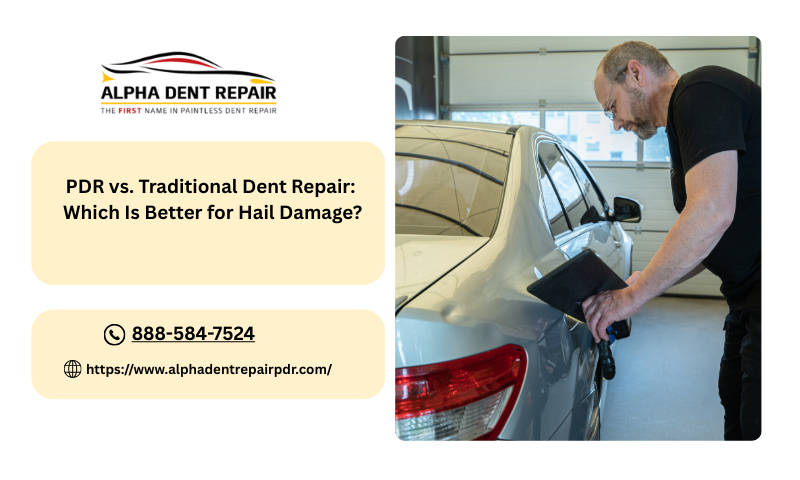
Paintless Dent Repair is a modern, non-invasive technique that removes dents without sanding, fillers, or repainting. PDR technicians use specialized tools to gently massage the metal back into shape from behind the panel.
Key Benefits of PDR for Hail Damage
1. Preserves Original Factory Paint
The most valuable aspect of PDR is that it maintains your car’s factory paint finish, which is stronger and more durable than aftermarket paint.
2. Faster Turnaround Times
While traditional body shop repairs can take several days or weeks, PDR can often be completed same-day, depending on dent severity.
3. Cost-Effective Repair
Without paint, materials, or extensive labor:
- Your repair costs are significantly lower
- Insurance companies often prefer PDR because it reduces claim payouts
4. Eco-Friendly Solution
PDR does not involve chemicals, paints, or fillers, making it the greenest dent repair method.
5. Ideal for Hail Damage
Because hail dents typically do not crack paint, PDR is the perfect match.
What Is Traditional Dent Repair?
Traditional dent repair requires:
- Sanding the damaged area
- Applying body fillers
- Repainting panels
- Blending colors to match factory paint
This process is more invasive and used when dents are too deep or when paint has been damaged.
When Traditional Dent Repair Is Needed
Traditional repair becomes necessary when:
- Paint is cracked or chipped
- The dent is too deep or sharp
- The metal is severely stretched
- Structural components are affected
While sometimes required, it has several drawbacks compared to PDR.
PDR vs. Traditional Dent Repair: Detailed Comparison
Below is a detailed breakdown of how both repair processes compare across key decision factors.
1. Repair Quality and Final Appearance
PDR
- Restores the panel to pre-hail condition
- Maintains the original factory finish
- No risk of mismatched paint or overspray
Traditional Repair
- Depends entirely on painter skill
- Higher risk of visible blend lines
- Factory finish is permanently altered
Winner: PDR
2. Time Required for Repair
PDR
- Same-day to 48 hours for most hail damage
- Ideal for busy schedules
Traditional Repair
- 3–7 days on average
- Can take longer for blending and curing
Winner: PDR
3. Cost and Insurance Coverage
PDR
- Typically 40–70% cheaper than traditional repair
- Insurance companies often recommend PDR for hail claims
Traditional Repair
- More expensive due to sanding, fillers, and painting
- Insurance may still cover it, but deductibles may apply
Winner: PDR
4. Vehicle Value and Resale Impact
PDR
- Maintains original body panels
- Retains resale value
- No mark on vehicle history if paint is untouched
Traditional Repair
- Repainted areas show up on paint thickness meters
- Can lower trade-in value
- Repair records often appear on vehicle history reports
Winner: PDR
5. Environmental and Safety Considerations
PDR
- No chemicals
- No VOCs
- No waste materials
Traditional Repair
- Uses paints, solvents, and fillers
- Produces chemical fumes and environmental waste
Winner: PDR
When to Choose Traditional Dent Repair Instead of PDR
While PDR is ideal for most hail damage, traditional repair is necessary if:
- The dent cracked the paint
- The hail caused sharp creases
- The panel is stretched beyond flexible repair
- Metal panels are torn, punctured, or severely misshaped
In these cases, traditional repair ensures structural stability.
Why PDR Is the Best Choice for Most Hail Damage Repairs
For the majority of hail-damaged vehicles, Paintless Dent Repair offers unmatched advantages. It is faster, more affordable, environmentally friendly, and preserves the value of your vehicle. Most hail dents fall well within the capabilities of skilled PDR technicians, making it the preferred solution among insurers and auto owners alike.
How to Know If Your Hail Damage Qualifies for PDR
You likely qualify for PDR if:
- Your dents are shallow
- Paint remains intact
- Damage is widespread but not severe
- Panels are not torn or cracked
A professional evaluation is essential to determine the most effective repair plan.
Choose the Best Hail Damage Repair Method
Selecting the optimal repair method after a hailstorm is crucial for maintaining your vehicle’s condition and value. In most cases, Paintless Dent Repair offers superior results, faster turnaround, and long-term benefits that far exceed traditional repair methods.
If your vehicle has recently suffered hail damage, trust the experts at Alpha Dent Repair to restore it quickly, affordably, and with precision. Our certified technicians specialize in advanced Paintless Dent Repair, delivering flawless results while preserving your vehicle’s original paint.
Contact Alpha Dent Repair today for a free inspection and fast, professional hail damage repair you can rely on. Your car deserves the best — and so do you.