Hail damage is repaired using either traditional auto body repair (filler, sanding, repainting) or Paintless Dent Repair (PDR), which reshapes the metal without repainting. PDR is faster, more cost-effective, and preserves factory paint when damage is minor to moderate. Traditional repair is required for deep dents, cracked paint, or structural damage.
Hail damage is repaired using either traditional body shop methods—filling, sanding, and repainting damaged panels—or Paintless Dent Repair (PDR), which carefully massages dents out from behind the panel without repainting. PDR is ideal for minor to moderate dents with intact paint, while traditional repair is necessary for severe damage or cracked paint.
Understanding Hail Damage on Vehicles
Hailstorms can leave vehicles covered in dents, dings, and surface damage. While most hail damage appears cosmetic, improper repairs can significantly impact resale value, insurance claims, and long-term corrosion resistance.
Types of Hail Damage
Hail damage typically falls into three categories:
- Minor dents (quarter-size or smaller) – No paint damage.
- Moderate dents (multiple panels affected) – Paint intact but widespread damage.
- Severe dents – Deep impact, cracked paint, or stretched metal.
Understanding which category your vehicle falls into determines whether Paintless Dent Repair (PDR) or traditional body repair is appropriate.
Traditional Hail Damage Repair
Traditional repair methods are commonly performed at full-service auto body shops.
How Traditional Repair Works
- Sand damaged area to bare metal.
- Apply body filler (Bondo).
- Sand smooth and reshape panel.
- Prime and repaint affected panel.
- Blend paint into adjacent panels.
- Clear coat and polish.
When Traditional Repair Is Necessary
- Paint is cracked or chipped.
- Metal is severely stretched.
- Dents are extremely deep or sharp.
- Structural damage exists.
Pros of Traditional Repair
- Works on severe damage.
- Suitable for paint damage.
- Can address structural issues.
Cons of Traditional Repair
- Higher cost.
- Longer repair time (days to weeks).
- Risk of color mismatch.
- Reduces factory paint integrity.
- Can reduce resale value.
Information Gain Insight: Factory paint is applied under controlled manufacturing conditions and baked at high temperatures. Repainted panels rarely achieve identical durability, which can affect long-term finish quality and corrosion resistance.
Paintless Dent Repair (PDR)
Paintless Dent Repair is a specialized technique used by experts like Alpha Dent Repair to restore panels without sanding or repainting.
How PDR Works
Technicians:
- Access the backside of the panel.
- Use precision tools to massage dents outward.
- Apply controlled pressure to reshape metal.
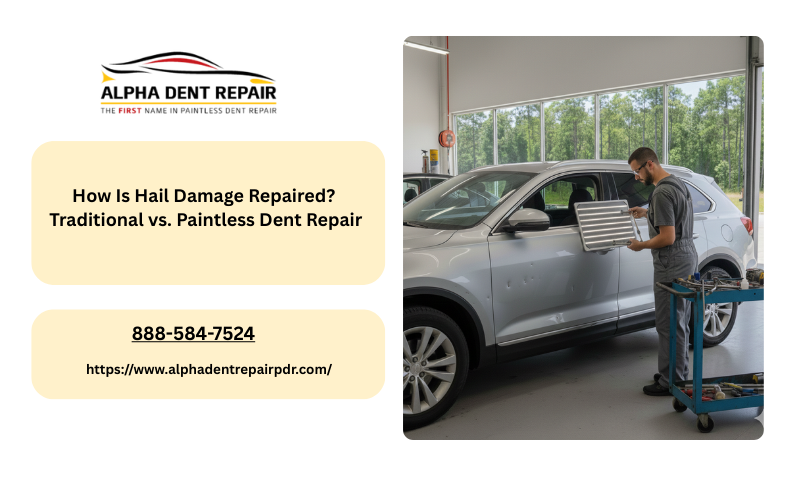
- Use LED reflection boards to ensure perfect alignment.
- Perform final detailing and quality inspection.
No fillers. No sanding. No repainting.
When PDR Is Ideal
- Paint surface is intact.
- Dents are shallow or moderate.
- Damage is widespread but cosmetic.
- Vehicle panels are aluminum or steel.
Advantages of PDR
- Preserves original factory paint.
- Faster turnaround (often same-day).
- More affordable.
- Maintains resale value.
- Eco-friendly (no chemicals or paint).
Traditional vs. Paintless Dent Repair: Side-by-Side Comparison
| Feature | Paintless Dent Repair (PDR) | Traditional Repair |
| Paint Preserved | Yes | No |
| Uses Fillers | No | Yes |
| Repair Time | 1–3 days | 3–14 days |
| Cost | Lower | Higher |
| Insurance Preferred | Often | Yes |
| Best For | Minor to moderate hail dents | Severe or paint-damaged dents |
| Resale Value Impact | Minimal | Potentially reduced |
Insurance and Hail Damage Repairs
Most comprehensive auto insurance policies cover hail damage.
Key Insurance Facts:
- Hail claims typically do not raise premiums.
- Insurance companies often prefer PDR when applicable.
- Claims may cover rental vehicles.
- Deductibles apply.
Pro Tip: After a hailstorm, document damage immediately with timestamped photos before debris or dirt interferes with inspection.
The Hidden Risk of Delaying Hail Repairs
Many vehicle owners delay repairs because dents appear cosmetic. However:
- Microfractures in paint can lead to corrosion.
- Insurance claims often have filing deadlines.
- Unrepaired dents reduce trade-in value.
- Lease return penalties may apply.
Modern vehicles use thinner metal panels to improve fuel efficiency. This makes dents more visible and potentially more damaging long-term if ignored.
How Technicians Determine Repair Method
Professional hail repair specialists evaluate:
- Dent depth and diameter
- Paint condition
- Panel location (roof, hood, door)
- Metal type (steel vs. aluminum)
- Access points behind panels
Advanced PDR technicians use specialized lighting systems and digital mapping tools to assess repair feasibility—technology not commonly discussed in standard body shop articles.
Why Factory Paint Matters
Factory paint:
- Is applied in dust-free environments.
- Undergoes electrostatic bonding.
- Is heat-cured for durability.
- Provides superior corrosion resistance.
Repainting a panel breaks this original seal. Even high-quality repaints cannot fully replicate factory curing processes.
This is why PDR is often considered the gold standard for cosmetic hail repair when paint is intact.
Choosing the Right Repair Shop
When selecting a hail repair specialist:
Look for:
- Certified PDR technicians.
- Insurance claim assistance.
- Warranty on repairs.
- Transparent estimates.
- Before-and-after documentation.
Alpha Dent Repair specializes in precision PDR, helping vehicle owners restore their cars quickly while preserving original paint and value.
Restore Your Vehicle the Right Way — Choose Alpha Dent Repair
Hail damage doesn’t have to mean repainting, body filler, or weeks in a shop. If your paint is intact, Alpha Dent Repair can restore your vehicle using precision Paintless Dent Repair—preserving your factory finish, protecting your resale value, and saving you time.
Why Act Now?
-
Prevent corrosion and long-term paint failure
-
Protect your trade-in or lease return value
-
File your insurance claim before deadlines expire
-
Get back on the road faster
Book Your Free Hail Damage Inspection Today
Our specialists will assess your vehicle, explain your options clearly, and work directly with your insurance provider to make the process simple and stress-free.
Call Alpha Dent Repair now or schedule your inspection online — and let us restore your vehicle with precision, speed, and care.